Welcome to Barn Goddess Fainters! 

I have a small herd of  fainting goats registered with the IFGA and I am committed to the raising and selling of quality fainting goats in an effort to further the breed.  Fainters are listed with the ALBC as a rare breed in need of preservation.  Please stop in and check out my herd Senior Does, Junior Does, and Bucks and their babies that are for sale.  You can also stop and say hi to the LaMancha dairy goats, or Liberty and Justice the LGDs.


Isis-ad.JPG


What is a fainting goat?                                                                                                                                         

Fainting goats are known by many different names, wooden-legged, stiff legged, epileptic, Tennessee fainting goat, nervous goats, ect.  In truth they have a genetic condition known a myotonia congenita.  The myotonia causes the goat to lock up when frightened or startled.  They are actually aware the entire time and it only lasts a few seconds.

Does the fainting hurt them?

No, in fact it helps build their muscles and fainters are considered to be a meat breed goat.  There are many speculations as to why they were bred in the first place, one being to protect sheep by giving the predator something easy to pick off.

I have heard goats are destructive, jump on things, and bucks in rut can be aggressive.

While other breeds of goats require higher fence, fainting goats are easy to fence in.  Their myontonic nature allows for a very limited jumping height.  Some of my fences are only 30-32 inches tall.  The myotonia also makes them more demure and docile even the bucks.  In the summer my main herd of does is even allowed to "free-range" weeds around our property.

What do you do with them?

Fainting goats are a meat breed of goat and several people bred them for just that purpose.  Their docility and ease of handling make them ideal pets and they are excellent brush clearers.  Mine are pets and have the run of our property during the day to clear weeds.  They are also fun to breed.  They are easy kidders, good mothers, produce plenty of milk for their kids, and twins are common.  Higher order multiples are not uncommon either.  I have been breeding them for four years and have had several sets of triplets, a set of quads and only three singles.

What do they eat?

Contrary to popular belief they should not eat cans, bottles, paper, cardboard, or plastic.  They are like little kids, just because they will put it in their mouth dosen't mean they should.  Fainters will eat pretty much any weed, can be placed on pasture, or fed some type of hay.  They also love treats like grain, melon rinds and carrots.  There are few plants which can be toxic like yews, oleander, milkweed, black nightshade, and leaves (especially wilted) from any tree that bears fruit with large pits, i.e. peaches, plums, and cherries.  A good idea would be to get a book or two on goats to have as a reference.  For poisonous plants this is also a good site:  http://kinne.net/poi-list.htm

Are there any disadvantages to the breed?

I would say there are mainly two disadvantages.  First, since they cannot run effectively when frightened they are more suceptable to predators.  If you have a predator problem you may want a stronger fence than they actually require or a guard animal like a Livestock Guardian Dog. 

Most breeds of goat can be bred to have their first kid when the doe is around one year of age (so they are exposed to the buck at nine months of age).  The myotonic condition of the fainting goat also makes the goat grow and mature more slowly.  It is recommended that they not be bred to kid until they are around two years of age (so they are exposed to the buck between 15-18 months of age).  This means you will have to feed your doe for a year before she will be bred to have any kids.

You keep saying does and bucks, I have heard nannies and billies?

While there is nothing wrong with calling them nannies and billies the proper names are does and bucks.  Either one will get the point across whether they are boys or girls.  Another term you may be unfamiliar with is wether.  A wether is a castrated male.  A wether is sold primarily as a pet or companion for another goat.

I'm convinced, where do I get one?

I am located near Columbus, Nebraska.  Visit my for sale page to see what I have avaliable.  If you don't find anything you like or I'm too far away contact me, I can probably help you find someone or visit the links page.  I warn you though, they are like potato chips, you can't have just one.


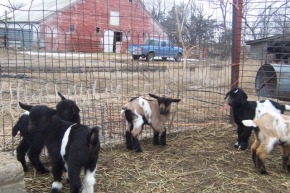
Quadruplets from 2007.
         
Member           


Thanks for Looking